+1 (720) 487-3589
inquiry@compasskin.com
The world says Everest is the highest mountain in the world but for a traveller it is more than just that. This journey of 12 days is a profound physical and mental journey. This 12-day journey is as much a physical experience as an emotional one, a deep cultural immersion into Sherpa tradition, set against the raw majesty of the Himalayas.
Kathmandu greets you first through Thamel’s narrow lanes — prayer flags strung between guesthouse rooftops, shopfronts stacked with down jackets and trekking gear, and the easy buzz of travelers swapping stories over their first plate of momos.
Two extraordinary squares and a stupa in a single day — medieval palaces framing courtyards where sadhus sit beneath carved temple struts, the scent of incense curls past pagoda rooftops, and artisans still shape wood, stone, and bronze in workshops their guilds have run for a thousand years. Monkeys reign over hilltop shrines, and the valley’s spiritual pulse is palpable at every turn.
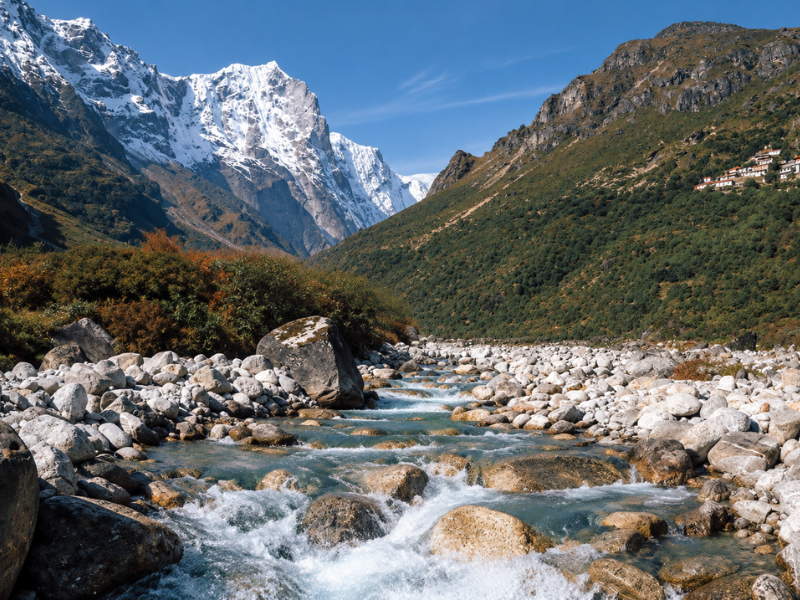
The rooftop of the world begins with one of the world’s most thrilling mountain runways. From Lukla — carved into a ridgeline above the clouds — the trail drops gently through silver fir and pine, the turquoise Dudh Koshi River rushing beside you all the way to Phakding’s warm lodge lights.
Start lodge: MLN Lukla · 9,383 ft
End lodge: MLN Phakding · 8,563 ft
Terrain: Gentle descent, river valley, suspension bridges
On arrival: Trek briefing, permit check; views over Dudh Koshi
The trail weaves through prayer-flag forests and mani stone walls etched with sacred mantras. At Pema Chholing Monastery, a resident monk leads a quiet blessing ceremony — the rhythmic drone of horns and the smell of juniper smoke setting an intention for the days ahead. Then Monjo: last village before the Sagarmatha National Park gates.
Terrain
Mixed ascent and descent, stone-paved, suspension bridges
Highlight
Prayer session & blessing at Pema Chholing Monastery
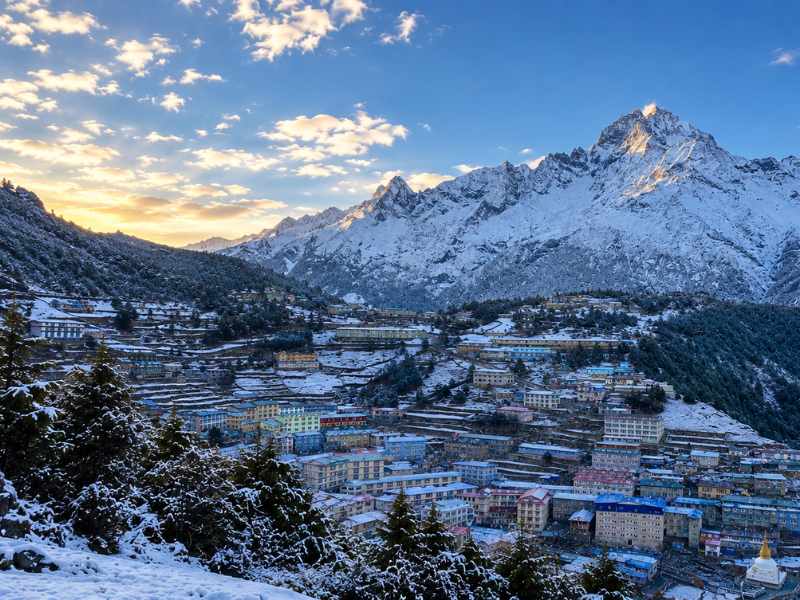
The Hillary Bridge — swaying high above the churning Dudh Koshi — marks the ascent into the Khumbu proper. A steep climb through rhododendron and pine ends at a hilltop clearing where, for the first time, the summit pyramid of Everest peers above the ridgeline. Refreshments are served here. Then up into Namche Bazaar, the Sherpa capital: a horseshoe-shaped amphitheatre of lodges, bakeries, and yak-herders at 11,500 feet.
Terrain
Forest trail, steep switchback climb to Namche saddle
Landmark
Hillary Suspension Bridge · first Everest glimpse
Lunch
Namche Bazaar — biggest town in Khumbu
Lodge
MLN Namche · 11,500 ft
Rest days at altitude are not passive — the body quietly building new red blood cells as you gain height without sleeping higher. The morning takes you to Sagarmatha Next, the Khumbu’s forward-thinking hub on climate and mountain sustainability. Then a ridgeline walk to Khumjung, where Sir Edmund Hillary built a school in 1961 that still educates Sherpa children today — and where the village monastery has quietly kept one of the Khumbu’s most intriguing relics: a 300-year-old Yeti scalp and skull, unlocked by a monk’s key and viewable on request.
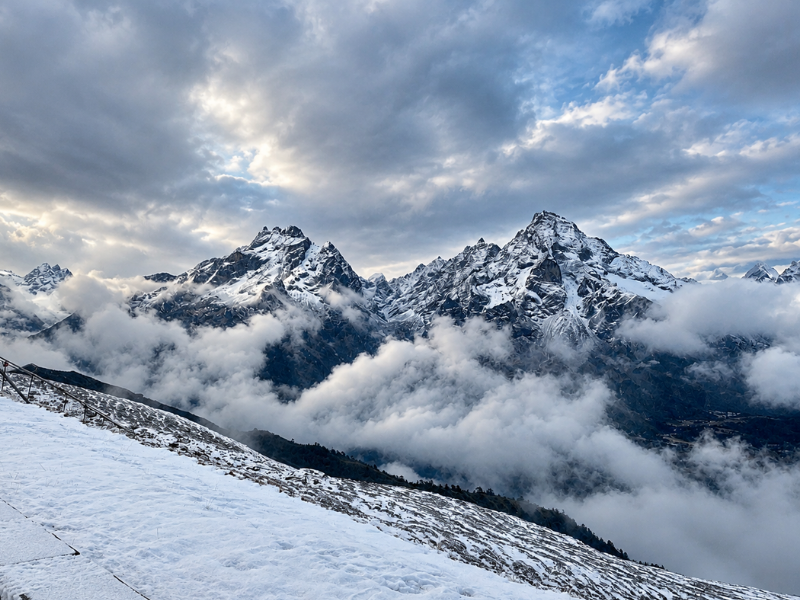
The trail climbs through high birch and rhododendron glades, crossing a suspension bridge before ascending to Tengboche — the Khumbu’s most sacred monastery, perched on a ridge with unbroken 360° views of Everest, Nuptse, Ama Dablam, and Thamserku. A short descent through silver fir forest brings you to Deboche, a hushed hamlet of stone houses and fluttering prayer flags.
Terrain
Undulating ridge walk; descent to Imja Khola valley
Tengboche
12,687 ft · founded 1916
Pangboche’s monastery — the oldest in the Khumbu, founded around 1667 — once housed what monks claimed was a genuine Yeti hand. The original was stolen in 1991 and its whereabouts remain unknown. In 2011 a replica hand and skull were delivered to the monastery, which the monks now display with the same quiet reverence as the original. Over butter tea afterward, an Everest summiteer joins the group for an intimate talk: the summit ridge, frostbite decisions at 28,000 feet, and Ama Dablam rising improbably graceful across the valley.
Monastery
Pangboche — est. ~1667, oldest in Khumbu
Relic
Replica Yeti hand & skull (original stolen 1991; replica gifted 2011)
Views
Ama Dablam · Thamserku · Island Peak
Terrain
Exposed rocky hillside, sub-alpine scrub
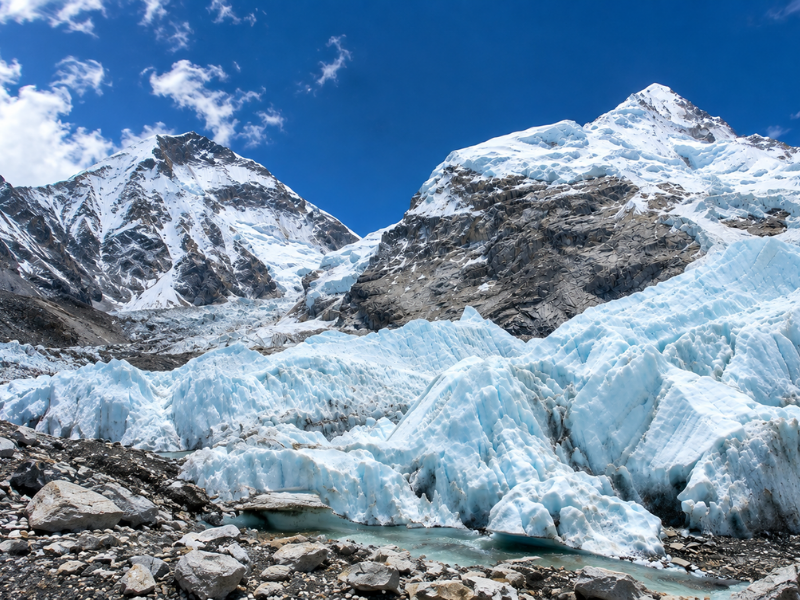
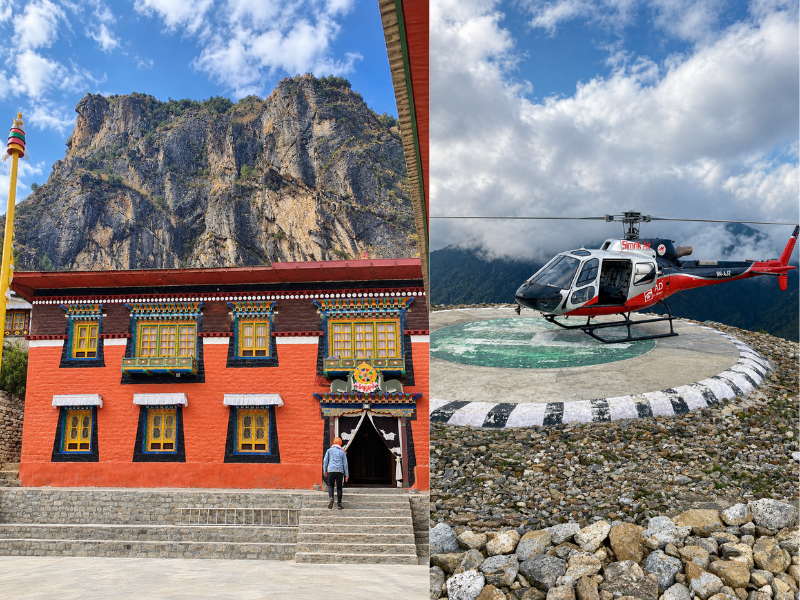
The helicopter lifts off from Deboche, ascending the Khumbu Valley as the peaks blaze copper in the first light. The pilot banks toward Everest Base Camp at 17,600 ft: the fractured seracs and deep crevasses of the Khumbu Icefall fill the window below — raw, elemental, and breathtaking at any season. Then a landing at Kongde, a hidden eyrie directly above the valley, ringed by Thamserku, Kangtega, and Everest itself. Breakfast here. Then on to Lukla: celebrate, laugh, share stories. The mountain has been earned.
MLN Kongde
13,940 ft · panoramic mountain perch
Overfly route
Khumbu Valley → EBC (17,600 ft) → Kongde
The mountains recede behind you as the flight drops back into the valley. The city hum of Kathmandu returns — traffic, marigolds, temple bells — a gentle re-entry after days of ridge and sky. The evening takes you to Pashupatinath Temple on the banks of the Bagmati, where the Aarati ceremony unfolds at dusk: oil lamps tracing arcs in the dark, sadhus chanting, the sacred river carrying embers downstream.
Bhaktapur – the best-preserved medieval city in Nepal — greets you with terracotta tile rooftops, ancient woodcarvers’ workshops, and the 55-Window Palace. A Newari lunch follows, then a costume photoshoot in traditional dress against the square’s centuries-old backdrop. At dusk, Boudhanath Stupa — one of the largest in the world — is luminous with a thousand butter lamps, monks circling the dome in a living mandala. A fitting farewell to Nepal.
The mountains stay with you — not just in photographs but in the body’s memory of thin air, the sound of prayer flags snapping in the wind, and the particular silence of a Himalayan dawn. A Compasskin representative escorts you to the airport. Until next time.




No, and no prior high-altitude experience is needed. But this isn’t a beginner’s stroll either. You should be comfortable walking for several consecutive days at altitude. Days 3 to 8 are trekking days (about 32 miles in total) on well-used trails with steep sections, stone steps, suspension bridges and steady climbs. On Day 9, a helicopter flies you over Everest Base Camp and down to Lukla, so you don’t retrace your steps on foot.
No. You don’t walk to Base Camp or sleep there. After trekking through the Khumbu, you fly over Everest Base Camp (about 17,600 ft) by helicopter on Day 9. That makes this a different experience from a conventional Base Camp trek, with lower sleeping altitudes and no retracing of your route.
Weather permitting, yes. Your first glimpse comes on the climb to Namche Bazaar (Day 5). You get more views around Khumjung and Tengboche, and the Day 9 helicopter flight takes you closest of all.
Yes, this destination requires travellers to be at least 12 years of age.
Good cardiovascular fitness is important. You’ll walk an average of 4 to 6 hours on most trekking days, on uneven trail with long stone staircases. The climb into Namche (Day 5) is the hardest day. Regular hikes with real elevation gain in the two to three months before you go are the best preparation.
Your highest hiking point would be below 14,000 ft which is lower than the sleeping elevations on a conventional Base Camp trek. This is worth remembering when comparing itineraries. The helicopter flight over Base Camp reaches about 17,600 ft, but you don’t stay there.
The route climbs gradually, with two nights in Namche (11,500 ft) and an acclimatization excursion toward Khumjung. It then continues through Tengboche, Deboche and Pangboche before the helicopter flight. Gradual ascent matters because altitude illness can affect travelers above roughly 8,000 ft. Your guide watches for signs of altitude sickness every day. Talk to your doctor before the trip about preventive medication.
There are several, including the Hillary Bridge high above the Dudh Koshi river. They’re sturdy and well maintained, and your guide walks with you if heights make you nervous.
Yes. The Day 6 hike to Khumjung is optional. You can stay in Namche, rest at the lodge or explore the bazaar instead.
By a short flight (about 30 minutes) from Kathmandu to Lukla’s mountain airstrip, the main air access point for the Everest region. In busy seasons, Nepal’s aviation authority sometimes moves Lukla flights to Ramechhap (Manthali), about 4 to 5 hours’ drive from Kathmandu. If that happens, we arrange the transfer.
Mountain weather can ground flights to and from Lukla, so schedules are subject to change. We build buffer days into the itinerary to absorb short delays. If bad weather lasts several days, we can arrange a helicopter, which can often fly when planes can’t, at an additional cost. Your guide keeps you updated throughout. We also recommend keeping some flexibility in your onward Nepal travel plans, and travel insurance that covers trip delays can help with any extra costs.
Yes, a licensed trekking guide and an agency-issued TIMS card are required on this route. Both are arranged for you. Current fees listed by the Nepal Tourism Board are NPR 2,000 for the TIMS card (non-SAARC applicants) and NPR 3,000 per person for entry to Sagarmatha National Park, which the route passes through. Fees can change, so confirm current amounts before departure.
Lukla flights have strict weight limits of 15 kg (33 lbs). Leave the rest at your Kathmandu hotel. Porters carry your main duffel between lodges, so you only carry a daypack.
Seven nights in Mountain Lodges of Nepal lodges, with private rooms, attached bathrooms with hot showers, and heated bedding. In Kathmandu, you stay at Nomad Kathmandu.
All breakfasts and lunches, plus 9 dinners. In the mountains, meals are served at your lodge.
The main trekking seasons are spring and autumn.
Autumn (October–December): the clearest skies after the monsoon.
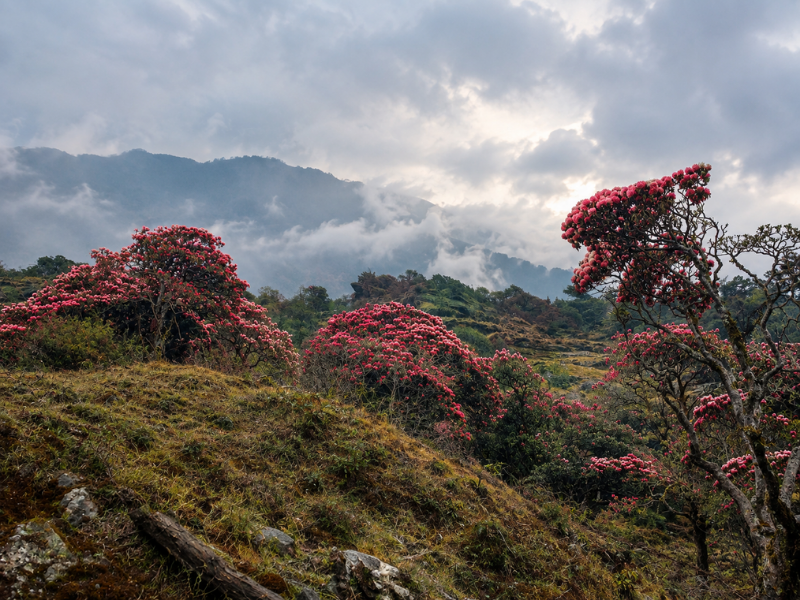
Spring (March to June): warmer days and rhododendrons in bloom.
